Hire The Crew You're Going To Dispatch Tomorrow
A complete hiring system built for moving and storage companies — job postings, a branded careers page, screening, interviews, and offers — inside the software that already runs your dispatch board, your HR records, and your payroll.
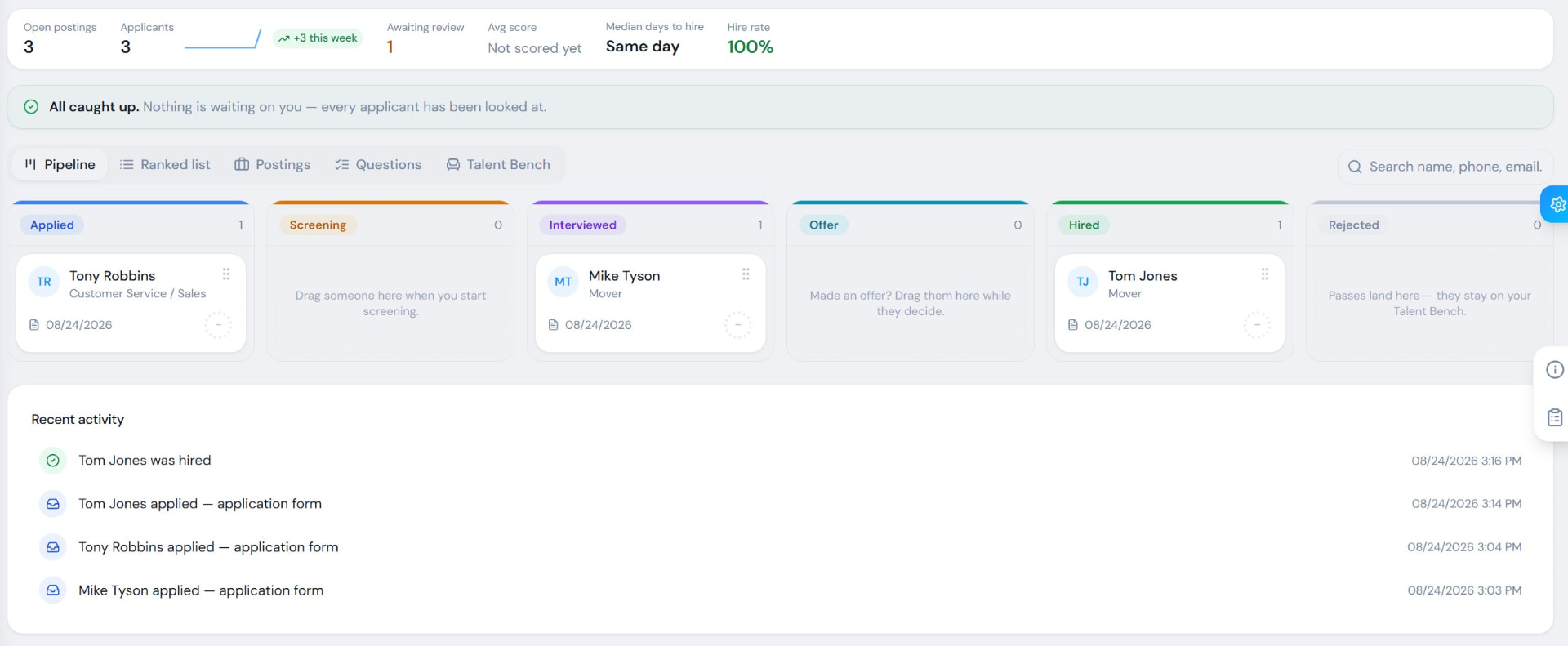
Every applicant moves left to right — and the board tells you who has been sitting still too long.
Hiring And Training, Side By Side
Movers Don't Lose Candidates To Better Offers. They Lose Them To Silence.
Applications land in three inboxes, a voicemail box, and a clipboard by the dock door. Somebody means to call everybody back on Monday. By Wednesday the good ones are loading somebody else's truck.
Busy season is exactly when nobody has time to hire — and exactly when you need six more people.
Applications go stale in days, not weeks. Whoever calls first, wins.
Nothing is written down. Who interviewed him? What did he say? Nobody remembers by Friday.
Last season's near-misses are gone — buried in an inbox nobody can search.
A Pipeline That Tells You What To Do Next
Drag applicants across five stages, or work them as a list. Cards tint amber after three days without movement and red after seven, so a stalled candidate is visible from across the room.
A To-Do List, Not A Database
Most hiring software can tell you three people applied. It can't tell you that one of them applied six days ago and nobody has opened the card. The queue is built from the same data the board is — no extra work, no separate tool — and it's the first thing on the page.
Applied → Screening → Interviewed → Offer → Hired, plus a Rejected side-exit that keeps the record.
Every card shows how long it's been sitting, tinted by how bad that is.
Kanban for working the queue, a sortable table for the manager who wants it all on one screen.
Five Ways To Apply. No Web Developer.
A careers page we host for you
Your logo, your hero photo, your accent color, your headline, your perks list — live at a link you can put anywhere. No website required.
One snippet on your own site
Drop in the full careers page, just the job board, or just the application form. It sizes itself to your page and inherits nothing you don't want it to.
A QR code for the real world
Stick it on the back of a truck, the break room door, or a yard sign. Applications that come in through it are tagged as such.
Text-to-apply links
Send a candidate straight to the form — or to one specific opening — from a text message, and know it came from there.
Called in or walked in
Somebody calls the office? Add them in ten seconds from the same board, and they're in the pipeline like everyone else.
Written for you, if you'd rather not
Four one-click copy presets — family-owned, high volume, white-glove, no-experience-needed — with a live preview as you build.
Postings That Match How A Moving Company Staffs
Every posting belongs to a branch, so the Northside yard's driver opening never gets confused with the Southside one. Set the role, the employment type, and a pay range you can show or hide.
An Application Form You Control, Question By Question
Twenty-three ready-made screening questions, grouped by what they're actually for. Turn each one on or off, mark it required or optional, or write your own. Go as short as name-and-phone, or as thorough as a full application.
Driving questions — license, clean record, DOT medical card, box-truck experience — only appear on driver postings. Applicants attach a résumé; it lands in private storage, not somewhere public.
An AI Interviewer That Answers The Hiring Line At 9 PM On A Saturday
Applicants call a number and get a real screening interview — asked one question at a time, in your company's voice, with natural follow-ups — while your entire team is out on moves.
Coming SoonYour number, or a menu option. Give hiring its own dedicated line, or add it as a choice on the number you already publish.
It can take the whole application by phone. No form on file? It collects their name, confirms the best callback number, and asks which role they want.
It asks your questions. Each posting points at a question pack, and the interviewer works through it in order.
You get everything back. A full transcript with speaker labels, a recording, and the call length — right on the applicant's card.
It knows what it isn't. It never scores out loud, never promises pay or a start date, and tells every caller a human reviews the interview.
Consent First, Every Single Call
The opening line discloses that it's an AI, that the call is recorded, and asks whether the caller is okay continuing. If they say no, it thanks them, points them at the online form, and hangs up. That consent is written onto their record word-for-word.
Five Starter Question Packs
Mover, Driver, Foreman, Customer Service, and a general pack — written for this industry and fully editable. Every question targets job-relevant evidence: experience, availability, physical readiness, licensure, logistics.
A Score With Its Reasoning Attached
Each applicant is graded from the best evidence available: the phone interview if there was one, otherwise their written answers. You get a score out of 100, a short summary, a breakdown by dimension with the reasoning behind each mark, and any red flags worth a second look.
The point isn't the number. The point is that when forty applications arrive during peak season, the ten worth calling today are already at the top.
It's a recommendation, never a decision.
Nothing in the system automatically rejects, advances, or messages anyone based on a score.
Disagree and say why.
Any manager with permission can replace the score with their own — a written reason is required, and the change is logged.
Human scorecards too.
After a real interview, your interviewer rates reliability, experience, attitude, and communication one to five, with notes.
Book It, Text Them, Remind Them — And Keep Every Word
Interviews land on the calendar
Book in-person or phone interviews from the applicant's card, pick the interviewer, and it shows up on the Office Calendar and their task list.
They get reminded twice
An automatic text the day before and another an hour before. No-shows are recorded as no-shows.
Call, text, and email from the card
Every message threads into the same Communications history as the rest of your company. Nothing lives on somebody's personal phone.
Applied, offered, hired, rejected
Each moment can fire an automatic text or email you wrote once — in the same builder you already use for customers.
Notes, files, and a timeline
Notes with an author and a timestamp, an attachment ledger, and a running history of every stage the applicant passed through.
Seasonal rehires merge cleanly
The same phone or email applying again gets flagged, and one click merges the two records — notes, files, interviews and all.
Everyone You Didn't Hire Is Still Worth Something In March
Every applicant who wasn't hired — including the ones you turned down — stays on the Talent Bench, searchable by score, role, stage, and how recently they applied. When the season turns and you need eight people by Thursday, you're calling a list, not starting over.
Hired Means Hired — In HR, Dispatch, And Payroll
One click turns an applicant into a real employee record, through the exact same path your HR team uses by hand. They're immediately assignable on the dispatch board, and their résumé stays in private storage where it belongs.
This is the part a standalone hiring tool can't do: the person you hired on Tuesday is on a truck on Wednesday, without anyone retyping their name.
The Questions Nobody Should Be Asking, Nobody Can Ask
Hiring is the part of running a moving company where an off-hand question turns into a real problem. So the guardrails aren't a training video — they're in the product.
The question library is pre-screened.
Every ready-made question targets job-relevant evidence only — experience, availability, physical readiness, licensure, logistics.
The AI interviewer is hard-blocked from protected topics.
Age, race, religion, sex, family plans, health, citizenship, arrest history. If a caller volunteers something, it acknowledges kindly and moves on.
The grader follows the same rules the interviewer does.
What may be asked and what may be considered are one policy, not two.
Consent is captured word-for-word.
The exact text an applicant agreed to is stored on their record, so you can show what they saw on the day they saw it.
Résumés stay private.
They live in locked storage, separate from your public employee files, and they stay there after the hire.
Score overrides are logged.
Who changed it, what it was, what it became, and the reason they gave.
The Things You'd Assume, Done Properly
Every branch runs its own hiring
Postings, applicants, and settings are branch-scoped, with company-wide defaults and per-branch overrides on every setting.
Seven separate permissions
Viewing the pipeline, seeing transcripts, managing postings, working applicants, overriding scores, converting to employees, and settings.
Metrics that answer real questions
Applications per day week-over-week, hire rate on decided candidates, median days to hire, and average applicant quality.
You hear about it immediately
New application and completed-interview notifications route to whoever should get them, through the system you already use.
Offers written down
Rate, period, start date, and terms recorded on the card, so the conversation three weeks later isn't a memory contest.
Don't want it? Turn it off.
Hiring is one switch away from invisible company-wide, and every public surface toggles independently.
Hiring Questions
Is Hiring an extra subscription?
No. Hiring is part of MoveitPro+. There is no separate applicant tracking system to buy, no second login, and no export-and-retype step between hiring and dispatch.
Do we need a website to post jobs?
No. We host a branded careers page for you at a link you can share anywhere. If you do have a site, you can embed the full page, just the job board, or just the application form.
How do candidates apply?
Five ways: your website, an embedded or hosted careers page, a printable QR code, a text-to-apply link, or a phone call your office staff logs on the board.
Can we control what the application asks?
Yes. Twenty-three ready-made screening questions grouped by purpose, each one optional, required, or off — plus your own. Driving questions only appear on driver postings.
What is the AI phone interviewer?
A screening interview by phone, in your company's voice, one question at a time with natural follow-ups. It discloses that it is an AI, that the call is recorded, and asks consent before continuing. Coming soon — not available in the first release.
Does AI make the hiring decision?
Never. Scores are recommendations with written reasoning attached. Nothing auto-rejects, auto-advances, or auto-messages anyone, and any manager can override a score with a logged reason.
What happens when we hire someone?
One click converts the applicant into a real employee record through the same path your HR team uses by hand — assignable on the dispatch board the same day, with their résumé kept in private storage.
What happens to the people we didn't hire?
They stay on the Talent Bench, searchable by score, role, stage, and recency. When the season turns and you need eight people by Thursday, you're calling a list instead of starting over.

Ready for the Next Chapter?
MoveitPro+ is now live — and we're onboarding a handful of companies each day to ensure every customer gets a white-glove setup. Reserve your spot today.
Book a demo • We will review your current lead flow, dispatch process, migration needs, and fastest path to launch